

 Meine Favoriten
 Abmelden
 Alle
Artikel online lesen
Alle
Artikel online lesen
 Weltwoche Schweiz


 Anhören ( 16 min )
 With Callista L. Gingrich, U.S. President Donald Trump has sent a close confidante to serve as ambassador to Switzerland and Liechtenstein. This is widely seen as a positive sign. Ambassador Gingrich is a sought-after diplomat among political and business leaders as well as the media, especially since the traditionally close ties between Switzerland and the U.S. have been tested by turbulence in recent times.
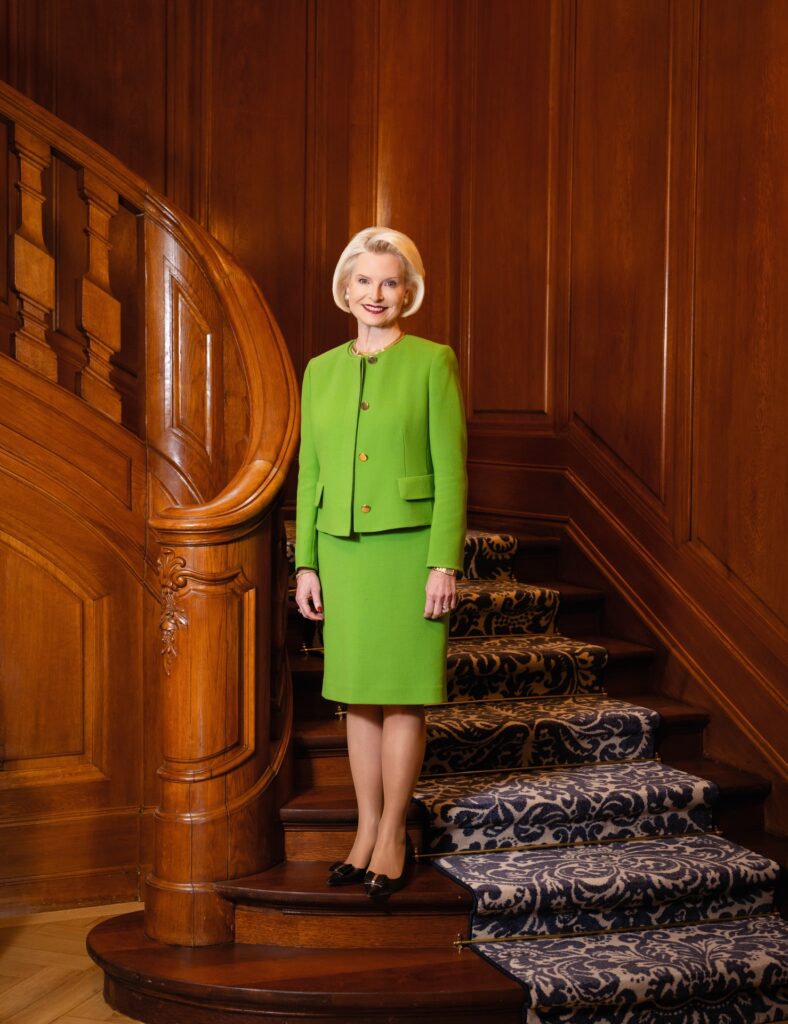
Raffael Waldner für die Weltwoche
Gingrich grew up in a Catholic family with Swiss and Polish roots. After studying music at Luther College in Iowa, she began her professional career as a congressional aide in the U.S. House of Representatives, where she met her future husband, Newt Gingrich, in the 1990s—then Speaker of the House and leader of the -“Republican Revolution”.
The couple founded Gingrich 360, a multimedia production and consulting company based in Arlington, Virginia. Callista Gingrich achieved great success with children’s American history books and made it onto the New York Times bestseller list.
Following her posting to the Holy See during Trump’s first term (2017–2021), Bern is Gingrich’s second ambassadorial post.
Ambassador Gingrich addresses pressing current issues for the first time in a media interview since taking office in October 2025. The interview was conducted in writing at the request of the U.S. Embassy.
Weltwoche: Madam Ambassador, it is a great honor to welcome you as a distinguished representative of the U.S. government in Bern. All the more so given that you personally have a Swiss background. What are your family’s roots in our country? Have you already had time to visit the place of origin in Chur?
Callista L. Gingrich: Thank you. It is an honor to serve as the United States Ambassador to the Swiss Confederation and the Principality of Liechtenstein. This assignment is especially meaningful to me personally, as my mother’s ancestors came from the cantons of Bern and Graubünden. I look forward to visiting the regions where my great grandparents lived and to learning more about my family’s Swiss heritage.
Weltwoche: In recent weeks you have toured our country and met with a number of Swiss key politicians and economic leaders. What has been the most memorable meeting so far?
Gingrich: I cannot choose just one, as I have been consistently impressed by the professionalism and warmth I have encountered in all my meetings with Switzerland’s political and economic leaders. What has been especially memorable are the conversations with Swiss government officials and business executives about how we can expand opportunity through trade, innovation, and workforce development. Switzerland’s commitment to excellence is not abstract – it is evident in the way its institutions function, in the strength of its dual-track vocational education system, and in the long-term thinking of its economic leaders. Those meetings reflect something fundamental about the U.S.-Swiss relationship: ours is a partnership built not only on shared interests, but also on shared values and a common commitment to creating opportunities for the next generation.
Weltwoche: You have close ties to President Trump. Do you have a direct line to the Oval Office if necessary?
Gingrich: I am honored to serve as President Trump’s Ambassador to the Swiss Confederation and the Principality of Liechtenstein, representing his Administration with great pride and a clear sense of purpose. As Ambassador, my responsibility is to ensure that this relationship remains strong, substantive, and effective. I maintain close contact with the White House and senior leaders across the Administration. I was especially pleased to welcome President Trump, along with other members of the Administration – including, Secretary Rubio, Secretary Bessent, Secretary Lutnick, Secretary Wright, and Ambassador Greer – to Switzerland in January for the World Economic Forum. Our relationship is strong, our communication is clear, and I am committed to ensuring that the partnership between our countries -receives the attention and engagement it deserves.
Weltwoche: During President Trump’s first term the United States and Switzerland have developed a very close and cordial relationship. Recently, we went through difficult times. What concrete steps do you intend to take to restore the bilateral relationship of our sister republics?
Gingrich: The U.S.-Switzerland relationship is strong and enduring. Enduring partnerships are built not only on government-to-government ties, but also through connections among institutions, and between people. For this reason, I value my engagements not only with the Federal Council, parliamentarians, and cantonal leaders, but also with the Swiss, Liechtenstein, and American business communities, participants in cultural and academic exchanges, and members of the public. Together, we are strengthening fair and balanced trade, expanding investment, driving innovation, advancing apprenticeships and workforce training, and securing supply-chain resilience. Our progress in these areas benefits both American and Swiss workers, supports businesses, and contributes to long-term prosperity in both countries. Switzerland is a trusted partner with whom we share a deep respect for freedom, federalism, enterprise, and responsibility. My goal is to build on that foundation with seriousness of purpose and confidence in what our two nations can achieve together.
Weltwoche: Many Swiss people view the policies of U.S. President Trump with great skepticism. To make matters worse the Swiss media largely reports on your administration’s agenda in an exaggeratedly negative and biased -manner. What do you intend to do to win the hearts and minds of the Swiss people for the Trump administration?
Gingrich: I am here to listen, to engage, and to further strengthen the already robust partnership between our two free and self-governing republics. The enduring strength of our relationship speaks for itself.
Weltwoche: In his address at the World Economic Forum in Davos U.S. President Donald Trump praised Switzerland as “an incredible brilliant place”, before he argued that our country prospers thanks largely to American largesse, declaring that “They’re only good because of us”. And he asserted that Switzerland “would no longer be Switzerland without the United States.” This statement came as a shock to many Swiss people. Based on your profound knowledge of the U.S. society, do the hardworking people of America back this view of -Switzerland?
Gingrich: Switzerland is truly an exceptional country. In the short time I have been here, I’ve witnessed a nation defined by remarkable achievement and independence. The United States holds Switzerland in high regard as a model of success, where prosperity has been built through discipline, innovation, and hard work. We look forward to continuing our partnership in ways that advance prosperity for both of our countries.
Weltwoche: In the same address President Trump was criticizing Switzerland for running a trade surplus of $41 billion with the United States. He said: “So they come in they sell their watches, no tariffs, no nothing, they walk away and make 41 billion dollars on just us”. Many representatives from politics and business in Switzerland argue that the combined trade balance should serve as a reference: While the U.S. has a deficit in goods, it maintains a sizeable surplus in services (estimated at $30 billion in 2024). When both are combined, the overall U.S. trade deficit narrows significantly to approximately $8 billion. Do you share this view? What does the current Swiss trade surplus look like according to the numbers available to you?
Gingrich: The United States and Switzerland share a robust and highly sophisticated economic relationship that includes trade in goods and services, investment, innovation, and job creation. My focus is on how we can continue to strengthen this partnership for the future. President Trump wants fair trade and to reverse the decades-long hollowing out of the U.S. manufacturing sector. That is why we are currently negotiating trade agreements with key trading partners. The agreement with Switzerland and Liechtenstein will be mutually beneficial. It will further strengthen our economic ties, reduce barriers to trade, create more American jobs, and drive innovation.
Weltwoche: President Trump officially explained that the lengthy phone call he had with the former Swiss president, Karin Keller-Sutter, last summer, was the reason for implementing the high tariff margin of 39 percent. Trump called Keller-Sutter “very repetitive” and “so aggressive”. You have met with federal councilor Keller-Sutter. How did you address this notorious phone call and the irritations that resulted from it? What common ground did you find in your talk with her?
Gingrich: I greatly appreciate the discussions I’ve had with Federal Councilor Karin Keller-Sutter, both at the start of my ambassadorship when she was President and as head of the Federal Department of Finance. It was an immense honor to visit St. Gallen with her and to meet again at the World Economic Forum in Davos. During our conversations, we explored a wide range of issues of mutual concern.
Weltwoche: At the end of February 2026, the U.S. Supreme Court declared the special tariffs imposed by President Trump on imports from numerous countries to be illegal. What is your advice to Switzerland on how it should proceed with the tariff negotiations?
Gingrich: We look forward to concluding a formal trade agreement with Switzerland and Liechtenstein in the near future. As the United States Trade Representative, Ambassador Jamieson Greer stated, “we are committed to continue implementing the President’s trade policy.” Despite the Supreme Court’s decision, the Administration has alternative means to address the issues at the heart of the President’s reciprocal tariff program. We appreciate that Switzerland and Liechtenstein, like many of our key trading partners, have been responsive and continued good-faith negotiations toward an agreement. We are confident that all trade agreements negotiated by President Trump will remain in effect.
Weltwoche: President Trump has lowered the tariff margin for Switzerland after further negotiations by our government and an intervention of prominent Swiss business leaders. But in his speech in Davos the President said that this “doesn’t mean it’s not going up”. What does the U.S. government expect from Switzerland in the current negotiations for a legally binding trade agreement? What are the remaining key differences at this moment?
Gingrich: We look forward to finalizing a formal trade agreement with Switzerland and Liechtenstein in the near future. The President is committed to ensuring fair trade with our partners and emphasizes that non-tariff barriers and unfair trade practices must be -addressed.
Weltwoche: At the World Economic Forum in Davos I asked U.S. Treasury Secretary Scott Bessent: What would it mean for Swiss-U.S. bilateral relationships, if Switzerland was siding more and more with the EU and depart from its traditional neutrality? Secretary Bessent said: “I would worry if you started emulating the EU policies of administration, bureaucracy, and economic sclerosis. And it would be very disappointing if Switzerland decided to get on the EU bandwagon, Talk first and not think about the consequences later”. How do you view a possible closer Swiss cooperation with the EU?
Gingrich: My focus is on strengthening the United States’ bilateral relations with Switzerland and Liechtenstein. The President has prioritized unleashing innovation and driving economic growth by addressing over-regulation that hinders our economies. Our countries have long benefited from open and innovative business environments, and I am committed to ensuring that these conditions continue to thrive.
Weltwoche: The Swiss government intends to reach a deal with the EU, signing a new comprehensive package of agreements, often referred to as “Bilaterals III”. Many in Switzerland, led by the Swiss People Party (SVP), view such an agreement as a “treaty of subjugation”. They argue that Switzerland would automatically have to adopt EU law, surrender its people’s rights, undermine direct democracy, and take on the entire EU bureaucracy. How do you view such a treaty with the EU? Could it endanger the cordial relationship with the U.S.?
Gingrich: The United States and Switzerland share an enduring and valued partnership. My priority is to further strengthen our bilateral relationship, particularly in the areas of trade and investment, while also identifying new opportunities for collaboration – including the implementation of our reciprocal exchange agreement on apprenticeships. Switzerland’s relationship with the European Union is a matter for the Swiss Parliament and the Swiss -people to decide.
Weltwoche: The Swiss “good offices” represent a long-standing foreign policy tradition – rooted in neutrality and impartiality – to facilitate peaceful conflict resolution. The strategy involves acting as a host state for negotiations or mediating conflicts. Recently Switzerland hosted negotiations between China and the USA, between Russia and Ukraine, and between Iran and the USA. How important is the Swiss neutrality for the Trump government? And how can Switzerland improve its good offices in your view?
Gingrich: We acknowledge and respect Switzerland’s neutrality and appreciate its role as our protecting power in Iran since 1980, which has ensured the continuation of essential diplomatic and consular functions in the absence of formal relations between the United States and Iran. We also value Switzerland’s good offices in maintaining open channels of communication and facilitating dialogue between parties in conflict.
Weltwoche: Part of “good offices” are the Swiss’ protecting power mandates. Most prominently the Swiss represent the U.S. interests in Iran. With what actions has Switzerland represented U.S. interests in Tehran since you have started your Ambassadorship? What concrete steps can Switzerland make as the war is waging in Iran?
Gingrich: We deeply appreciate the dedication of the Swiss Embassy staff in Tehran and the Swiss Protecting Power for their efforts to represent and safeguard U.S. interests and support our citizens. We respect the Swiss government’s decision to temporarily close its embassy in Iran during this time.
Weltwoche: Due to the war in Iran, Switzerland has prohibited the U.S. from flying two military aircraft over its territory. According to our government, the law of neutrality prohibits overflights by parties to the conflict in connection with the war. Does the United States understand this decision based on Swiss neutrality? The Federal Council is also responding to the U.S. war against Iran by suspending the issuance of new licenses for the export of military equipment to the United States. Existing licenses and exports of other goods will be reviewed by a group of experts. How does your government assess this decision?
Gingrich: We remain in close communication with Switzerland on global developments, including in the Middle East, and we greatly appreciate the important role Switzerland has played as our protecting power in Iran for more than 45 years.
Weltwoche: There is a lot of confusion among Swiss people about the supposed fixed price for the procurement of the F-35 fighter jets. While Switzerland initially claimed a fixed price of roughly CHF 6 billion based on a 2020 referendum, the U.S. government recently informed Switzerland that no such fixed price deal exists. Can you explain how this discrepancy arose? Is there a misunderstanding on the part of the Swiss government?
Gingrich: The United States remains committed to working closely with Switzerland on the F-35 procurement and to strengthening the bilateral defense relationship between our countries. The recent F-35 cost increase has affected all nations operating the aircraft, including the United States.
Weltwoche: Where do you see the biggest threats for Switzerland, and for Europe, in the near future?
Gingrich: The United States continues to cooperate closely with Switzerland on the defense and security aspects of our partnership. Swiss counterparts have emphasized that cyber threats, organized criminal activity, and espionage – particularly from Russia and China – remain among the most significant challenges. The implementation of the State Partnership Program between the Colorado National Guard and the Swiss military will further strengthen our relationship, providing an additional layer of collaboration as our citizen soldiers train together and learn from one another.
Weltwoche: At the Embassy you have your husband by your side, the former Speaker Newt Gingrich, a profound expert in domestic and international politics. How does he assist you in your daily work as Ambassador? Do you reflect on and discuss topics with him?
Gingrich: I am grateful for the support of my husband as I work to advance President Trump’s policy priorities and represent the United States in Switzerland and Liechtenstein. My 19 years of experience in Congress, combined with my prior service as U.S. Ambassador to the Holy See, have prepared me well for this role. In addition, my experiences as a business executive, author, and documentary film producer have been invaluable during my second ambassadorship. Newt and I both love traveling across Switzerland, meeting its wonderful people, and experiencing the country’s stunning landscapes.
Weltwoche: During President Trump’s first term Switzerland rose from 8th to 6th largest direct foreign investor, which is remarkable for such a small country. What is your agenda for the bilateral relationship? What are key goals you intend to achieve?
Gingrich: My goal is to strengthen an already important relationship and work to make Switzerland our fifth-largest foreign direct investor. The United States and Switzerland share a remarkable partnership, built not only on trade and investment, but also on common history, values, and interests. President Trump’s goal is to create a cadre of one million apprentices in the United States. We view Switzerland’s apprenticeship system as the gold standard and are eager to collaborate with Swiss and Liechtenstein businesses and apprentices who wish to support this initiative. The reciprocal exchange agreement the United States established with Switzerland in 2024 represents a key step toward achieving this goal.
Weltwoche: What is on top of the lists of places you wish to visit in Switzerland?
Gingrich: Newt and I have been delighted by our travels across Switzerland. We recently traveled to St. Moritz and Zermatt. We are eager to continue exploring more of the country’s historic cities, mountain communities, and regions that reflect the richness of Switzerland’s history and culture. I am also interested in visiting places that showcase Swiss innovation and local traditions, as these are such important aspects of Switzerland’s identity.
Weltwoche: Have you already attended a traditional “Schwingfest”, Swiss wrestling festival? We think that “Schwingfeste” embody the DNA of our country.
Gingrich: It would be a great privilege to accompany you. I have not yet had the pleasure of attending a Schwingfest, but I would be delighted to do so. I greatly value opportunities to spend time in settings that offer insight into the character of a nation and its people. I would be pleased to attend any event that reflects Switzerland’s pride in tradition, strong community ties, and deep respect for its -heritage.
Weltwoche: We thank you, Madam Ambassador, for your time and your dedication to strengthen our outstanding bilateral relationship.