

 Meine Favoriten
 Abmelden
 Alle
Artikel online lesen
Alle
Artikel online lesen
 Weltwoche Schweiz

In his 1961 farewell address, President Dwight Eisenhower warned of “the acquisition of unwarranted influence… by the military-industrial complex.” Eisenhower feared that the size and power of the “complex,” or cluster, of government contractors and the Department of Defense would “endanger our liberties or democratic processes.” How? Through “domination of the nation's scholars by Federal employment, project allocations, and the power of money.” He feared public policy would “become the captive of a scientific-technological elite.”
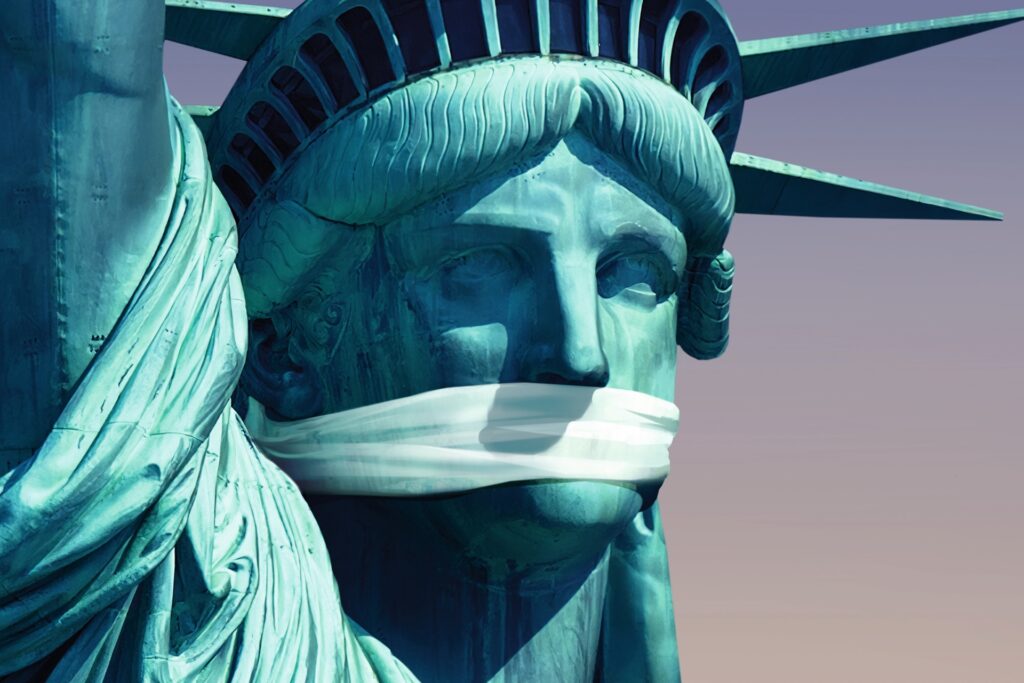
Eisenhower’s fears were well-founded. Today, American taxpayers are unwittingly financing the growth and power of a censorship-industrial complex run by America’s scientific and technological elite, which endangers our liberties and democracy. I am grateful for the opportunity to offer this testimony and sound the alarm over the shocking and disturbing emergence of state-sponsored censorship in the United States of America.
The Twitter Files, state attorneys general lawsuits, and investigative reporters have revealed a large and growing network of government agencies, academic institutions, and nongovernmental organizations that are actively censoring American citizens, often without their knowledge, on a range of issues, including on the origins of COVID , COVID vaccines , emails relating to Hunter Biden’s business dealings , climate change , renewable energy , fossil fuels , and many other issues.
I offer some cautions. I do not know how much of the censorship is coordinated beyond what we have been able to document, and I will not speculate. I recognize that the law allows Facebook, Twitter, and other private companies to moderate content on their platforms. And I support the right of governments to communicate with the public, including to dispute inaccurate and misleading information.
But government officials have been caught repeatedly pushing social media platforms to censor disfavored users and content. Often, these acts of censorship threaten the legal protection social media companies need to exist, Section 230.
“If government officials are directing or facilitating such censorship,” notes George Washington University law professor Jonathan Turley, “it raises serious First Amendment questions. It is axiomatic that the government cannot do indirectly what it is prohibited from doing directly.”
Moreover, we know that the U.S. government has funded organizations that pressure advertisers to boycott news media organizations and social media platforms that a) refuse to censor and/or b) spread disinformation, including alleged conspiracy theories.
The Stanford Internet Observatory, the University of Washington, the Atlantic Council’s Digital Forensic Research Lab, and Graphika all have inadequately-disclosed ties to the Department of Defense, the C.I.A., and other intelligence agencies. They work with multiple U.S. government agencies to institutionalize censorship research and advocacy within dozens of other universities and think tanks.
It is important to understand how these groups function. They are not publicly engaging with their opponents in an open exchange of ideas. They aren’t asking for a national debate over the limits of the First Amendment. Rather, they are creating blacklists of disfavored people and then pressuring, cajoling, and demanding that social media platforms censor, deamplify, and even ban the people on these blacklists.
Who are the censors? They are a familiar type. Overly confident in their ability to discern truth from falsity, good intention from bad intention, the instinct of these hall monitor-types is to complain to the teacher — and, if the teacher doesn’t comply, to go above them, to the principal. Such an approach might work in middle school and many elite universities, but it is anathema to freedom and is an abuse of power.
These organizations and others are also running their own influence operations, often under the guise of “fact-checking.” The intellectual leaders of the censorship complex have convinced journalists and social media executives that accurate information is disinformation, that valid hypotheses are conspiracy theories, and that greater self-censorship results in more accurate reporting. In many instances, censorship, such as labeling social media posts, is part of the influence operation aimed at discrediting factual information.
The censorship industrial complex combines established methods of psychological manipulation, some developed by the U.S. Military during the Global War on Terror, with highly sophisticated tools from computer science, including artificial intelligence. The complex’s leaders are driven by the fear that the Internet and social media platforms empower populist, alternative, and fringe personalities and views, which they regard as destabilizing. Federal government officials, agencies, and contractors have gone from fighting ISIS recruiters and Russian bots to censoring and deplatforming ordinary Americans and disfavored public figures.
Importantly, the bar for bringing in military-grade government monitoring and speech-countering techniques has moved from “countering terrorism” to “countering extremism” to countering simple misinformation. The government no longer needs a predicate of calling you a terrorist or extremist to deploy government resources to counter your political activity. The only predicate it needs is simply the assertion that the opinion you expressed on social media is wrong.
These efforts extend to influencing and even directing conventional news media organizations. Since 1971, when the Washington Post and New York Times elected to publish classified Pentagon papers about the war in Vietnam, journalists understood that we have a professional obligation to report on leaked documents whose contents are in the public interest, even when they had been stolen. And yet, in 2020, the Aspen Institute and Stanford’s Cyber Policy Center urged journalists to “Break the Pentagon Papers principle” and not cover leaked information to prevent the spread of “disinformation.”
Government-funded censors frequently invoke the prevention of real-world harm to justify their demands for censorship, but the censors define harm far more expansively than the Supreme Court does. The censors have defined harm so broadly, in fact, that they have justified Facebook censoring accurate information about COVID vaccines, for example, to prevent “vaccine hesitancy.” Their goal, clearly, is not protecting the truth but rather persuading the public. That is the purpose of open debate and the free exchange of ideas. Persuasion by covert means is censorship.
And, increasingly, the censors say their goal is to restrict information that “delegitimizes” governmental, industrial, and news media organizations. That mandate is so sweeping that it could easily censor criticism of any part of the status quo from elected officials to institutions to laws. This extreme, reactionary attitude is, bluntly, un-American.
Congress should immediately cut off funding to the censors and investigate their activities. Second, it should mandate instant reporting of all conversations between social media executives, government employees, and contractors concerning content moderation. Third, Congress should limit the broad permission given to social media platforms to censor, deplatform, and spread propaganda.
Whatever Congress does, it is incumbent upon the American people to wake up to the threat of government censorship via behind-the-scenes pressure on media corporations. “Only an alert and knowledgeable citizenry,” Eisenhower noted, “can compel the proper meshing of the huge industrial and military machinery of defense with our peaceful methods and goals so that security and liberty may prosper together.”
Editor’s note: Michael Shellenberger has offered this text for reprint in Die Weltwoche. It is a slightly edited version of his testimonial before the House Judiciary Select Subcommittee on the Weaponization of the Federal Government on March 9th 2023 in Washington D.C.