

 Meine Favoriten
 Abmelden
 Alle
Artikel online lesen
Alle
Artikel online lesen
 Weltwoche Schweiz


 Anhören ( 11 min )
 Edward T. McMullen was a key figure on the sidelines of the tariff negotiations—and their ultimate success.
In his first in-depth interview about the negotiations in months, Donald Trump's friend and former ambassador to Switzerland shares his perspective on how the agreement came about.
The business leaders played a “decisive role,” he says, but there was “no single group, person, or thing that brought this to a successful conclusion. Everything was well planned and orchestrated. The Swiss are brilliant at diplomacy.”
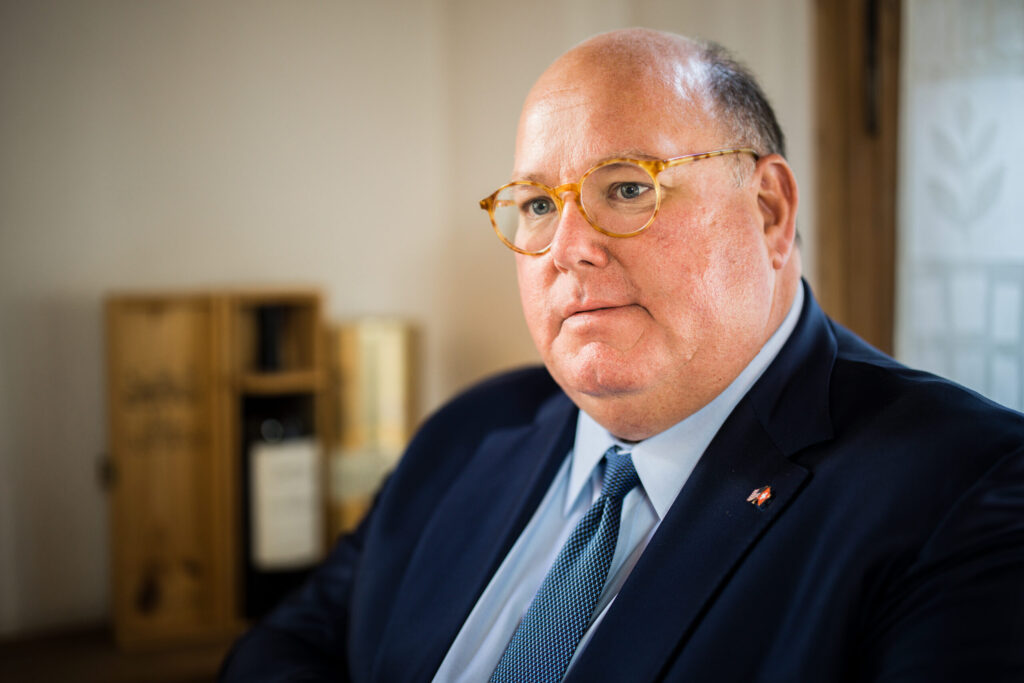
STEFAN BOHRER / KEYSTONE
McMullen has less kind words for the press. “It’s amazing how false many news reports were,” he tells Weltwoche. “They were meant to undermine the US Swiss relationship.”
Some “ideological leftists will go to no end without misinformation, disinformation and push their agenda to make Switzerland a part of the EU,” he adds.
Recent comments that President Trump demanded to the business community that Switzerland come into compliance with the US Position on China and Russia McMullen calls “ridiculous”. “They were just fabricating this.”
Trumps former emissary in Bern and now businessman doesn’t think that Switzerland is “stuck at 15 percent” tariffs. He has “great faith” that the new US Ambassador in Bern, Callista Gingrich, will continue the “discussion for the strongest bilateral relationship that we could have in Europe.”
Weltwoche: Ambassador McMullen, the deal is made. We are now down from 39 to 15 percent tariffs, the same level as the EU. How did we get here?
Edward T. McMullen: Let me backtrack. On Liberation Day (April 2nd) when President Trump announced that there would be a change in the trade policy, there was no surprise. The president campaigned on it. His team looked at where there were disparities.
The Swiss immediately, from day one, came out of the box. The Swiss government and the business community were determined not to be confrontable but work with the administration to get the facts out about the importance of the bilateral trade relationship. And they did a fantastic job.
Weltwoche: The negotiations seemed to have progressed fast and well.
McMullen: Yes. Everybody was eager to move forward. Secretary of Treasury Scott Bessent himself said in a live link to the conference of the American Swiss Foundation in Rüschlikon, Switzerland, in early June, that we were close to a deal. Far ahead of the EU. Far ahead of anyone else. Then, there was a bump in the road. And there was several months delay. Too much water went under the bridge.
Weltwoche: Who was causing this delay?
McMullen: The Swiss only can answer why those delays occurred.
It's pretty clear that there were those who thought, the US was not the priority. There were no delays on the US side. But the delays put the president of Switzerland (Karin Keller-Suter) in a difficult position and then she tried to get finality of the agreement, at the 11th hour.
Weltwoche: Many of our sources told us with certainty, that president Keller-Sutter’s demeanor on the phone call angered President Trump. Fact is, that Switzerland woke up to a 39 percent tariff hammer on national day. But nevertheless, the Swiss did not give up. How do you view the Swiss’ reaction to the high tariffs?
McMullen: Vice President Guy Parmelin along with the negotiating team and the business community in Switzerland came together. Most importantly, the business community worked hand in hand with the government, because they have the most at stake here. They had the most to lose. Because they were the ones investing in the U.S., trying to get the market share, answering to their stockholders. And they were determined to make sure that discussions moved rapidly and quickly.
Weltwoche: The intervention of the business leaders was received in the media with great skepticism, if not outright rejection. The NZZ headlined «Managers step in where Swiss diplomacy fails».
McMullen: No, they didn’t take over and they didn't do the negotiating, but they definitely came to the table to make the case that it was important. All in coordination with the Swiss government.
Then you also had the ridiculous comments being made in the press, this past week where they recapped from sources that President Trump demanded to the business community that Switzerland come into compliance with the US position on China and Russia.
They're just fabricating this.
Weltwoche: The Swiss Sunday press made this allegation first. And the NZZ reported: “’Cowboy world politics’: Swiss politicians react with outrage to Donald Trump's meeting with business leaders.”
McMullen: Well, here's what's so unfortunate. Because I talked to both people from the US side and the Swiss side. Never once did the word “Russia” or “China” get raised by the President in that meeting. No one respects Swiss sovereignty more than the United States. It has played a huge role in the importance of our relationship on many fronts. Foreign policy fronts. Economic fronts.
This is why I stopped talking to the press. Because everyone would speculate on things that were not actually true.
If I had to do a postmortem on this, now, I would say that there is a small band of ideological leftists who just don't like the United States. And they will go to no end without misinformation, disinformation and push their agenda to make Switzerland a part of the EU. I am really surprised to see how aggressive and how willing they were to push misinformation and disinformation and not even attempt to get the truth.
It’s amazing how false many news reports were. And how they were meant to undermine the US Swiss relationship. Now we can go back and see who is right, who is wrong.
Weltwoche: The powerful business community made the case for strong bilateral relations and lower tariffs, and they were successful. How important was their intervention?
McMullen: The president was well aware of the importance and told them, “I'm ready to move this ball forward.” And, and that's what's happened. They quickly charged his team to get to conclusion. Last Thursday (November 13th) there was a discussion with the see key components, the key players of the government. And Friday (November 14th) then announcement that the president is moving forward. And things are finally back on track.
I just spent five days in Switzerland right after the visit of the business leaders. And I spent time with our new ambassador, Callista Gingrich, and her husband. And I spoke to a large group of business leaders. And then I had individual dinners with many different Swiss citizens. Each and every one of them were people who cared about moving the bilateral relations. Each and every one of them understood the importance of the business community's meeting last week and how it played a pivotal role.
But let me add this: There's no one group or person or one thing that brought this to a successful end.
Everything was well planned and orchestrated. The Swiss are brilliant at diplomacy. And those who were prioritizing this relationship and wanted to see it to continue to strengthen, worked overtime, whether they were in the government, whether they were in the private sector of American diplomats.
The negotiating team, led by Helene Budliger from the SECO, was indispensable. Budliger was literally 24/7 focused on getting this done. She had the amazing support of her boss, vice president, Guy Parmelin, who knows Donald Trump, who'd met the President at the WEF in Davos twice during his first term. Who has a relationship with him. Who understands him as a businessman, who's talked with him, and who's met with Scott Bessent.
The shuttle diplomacy played a critical role here. Yes. The business leaders went early November and helped move the ball forward. But you cannot underestimate the value of that shuttle diplomacy that was done by SECO. I was stunned at the effectiveness, the understanding, the knowledge and the determination to do what was right for Switzerland.
Weltwoche: Symbolism can play a very important role in politics. At the men’s final of the US Open President Trump along with high ranking members of the administration were in the Rolex VIP box, hosted by the Swiss company’s chief executive Jean Frédéric Dufour. How important was that gesture to bring negotiations forward?
McMullen: I've known Mr. Dufour and the Rolex team since I was ambassador. It is one of the best running companies. It is a group of absolutely committed patriots to Switzerland. Dufour took it upon himself to invite the presidents to come to the US open for the men's final, at the height of the tough tariff negotiations.
He knew that the President loved tennis, and wanted the opportunity not to negotiate, but to show the importance of Swiss US relationship. And in doing that, the president brought a large number of his team.
Weltwoche: You were there, too, right next to the President. Was trade discussed?
McMullen: I was extremely impressed at the time. Four hours at the tennis tournament, and no one raised trade. But inevitably, it came up thanks to the president inquiring. And they had a very positive discussion. I mean, I'm not going to discuss what they discussed in their private conversation. But Mister President walked away and the team walked away knowing and understanding that the Swiss are truly a strong friend and they continue to be, moving forward. So, I think that started a very good dialog. And then the inevitable meeting in the Oval Office last week was decisive.
Weltwoche: The press reported heatedly about gifts – a watch and gold bars - that business leaders had given to President Trump.
McMullen: You know, you've got these leftists again screaming about Rolex gave him a watch. That wasn't even true. That makes it sound like he's walking around with a watch. Yeah. He's not. They didn't give him a watch. They gave him a desk clock. That literally will go to the presidential library. It's not his personal gift. It sits in the Oval Office, and it's a great reminder of Swiss US bilateral relationship.
And the gold bars they gave, they were imprinted with the Statue of Liberty and, showing the importance of US Swiss relations on gold. Those also go to the library. They're not the president's possessions. So, these people want to make it look like there was some nefarious effort here. It is ridiculous.
Every person visiting the President brings some kind of gift. That’s standard protocol.
Weltwoche: Let’s look ahead. The new framework agreement ranks Switzerland at 15 percent tariffs. Does that mean that we're stuck at 15%?
McMullen: No. There's still opportunity to have more discussions. And those discussions will transpire to make Switzerland even more competitive. You know, when I was there as US Ambassador we discussed a free trade agreement. Hopefully those discussions will continue.
Our new ambassador Callista Gingrich and her husband Newt are so committed to the trade relationship being strong and positive. I have great that Ambassador Gingrich will carry that ball and be a leader like we need to continue that discussion for the strongest bilateral relationship that we could have in Europe.
Weltwoche: The strongest in Europe, this sounds flattering, but is it realistic?
McMullen: Absolutely. Because Switzerland has the unique advantage of being a sovereign nation that speaks for itself strongly, loudly and effectively.
The EU has the deficit of having a bureaucracy in Brussels that can't even get an agreement on bottle caps let alone trade agreements.
Weltwoche: A last word about yourself. You played an active role behind the curtain. The President is your friend. So is the Secretary of Treasury Scott Bessent. How instrumental were you during this difficult phase of our relationship?
McMullen: We need to be very clear on my role here. I am the former US ambassador to Switzerland. On behalf of President Trump, I worked very closely with business leaders enabling Swiss investment in the US to go from number eight to number six.
And I am very proud of that success and having those relationships. I understand very clearly, as a former ambassador, my role is not to engage in negotiations and never did I engage in negotiations.
However, when I was asked about my perspective, I was very willing to share that perspective because I've worked for the president. I've worked for his team. I know his team, and I know what their objectives are.
So, there should be no confusion here about my role. Fortunately, most business leaders in Switzerland understand that. And most of the senior leaders in the government understand. I did not participate or advance negotiations. That was and never is my role as a former ambassador.
Weltwoche: You have been a staunch optimist all along. But when the negotiations dragged out, and the bad news came on August 1st. the press started to criticize you, saying you had placed too much hope in things that were not delivered. How did you take those hits?
McMullen: I'm a big boy, in many ways. I love your country. I love the people. And I'm well aware that there are some who try to use people in the media to create their narratives.
When I was in Switzerland this past week, everyone I knew was telling me how much they appreciated my continued and deep relationship with Switzerland.
In the end, they can write what they want in fantasy, and it is very clear that my interest in Switzerland is because I love the country. I spend summers in Switzerland. I have skied and played golf in Switzerland since I was young man.
I do whatever I can to work for a positive bilateral relationship and advocate for it as a citizen. But, I honestly don't let these negative forces bother me. People who are honorable, good people know what's true and what's not true innately. Those who know me know exactly where I stand.