

 Meine Favoriten
 Abmelden
 Alle
Artikel online lesen
Alle
Artikel online lesen
 Weltwoche Schweiz

Switzerland's tariff negotiations with the Trump White House had an auspicious start. When US Treasury Secretary traveled to Geneva in May, he told Weltwoche that Swiss leadership had done "a very good job engaging, moving to the forward front of the queue."
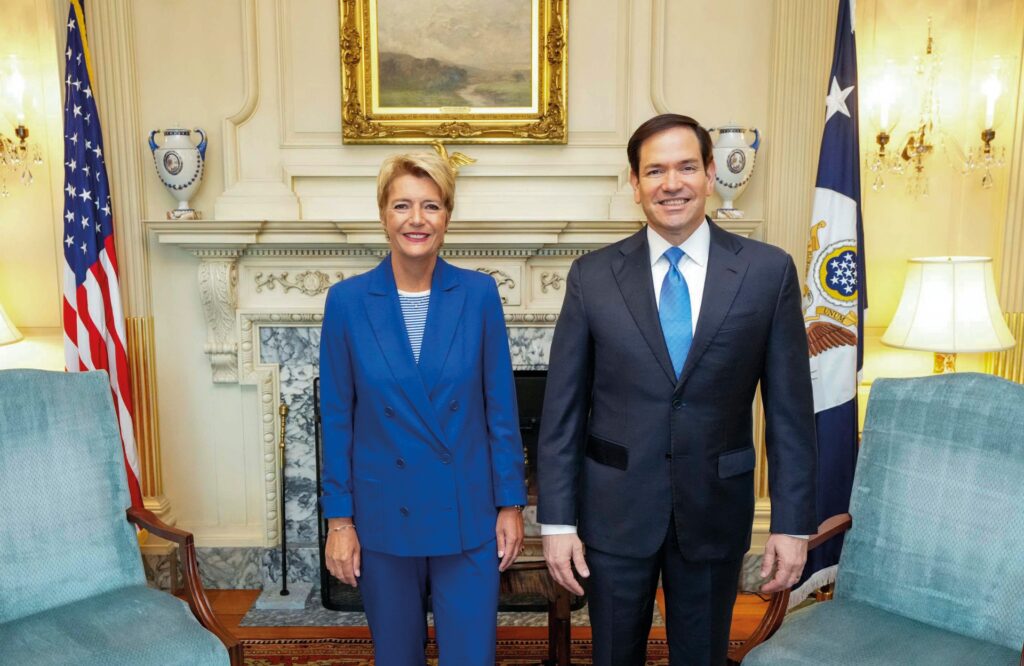
Freddie Everett/US State Department
By early June, a deal seemed within reach. Bessent appeared live, on-screen at an event held by the American Swiss Foundation in Switzerland and praised the connection between the "sister republics."
"Our two countries are among the most dynamic in the world," Bessent declared. "And our combined dynamism is an unstoppable force for good on the global stage." The cabinet official's words felt like a gust of welcome wind filling Swiss sails.
One members of the American delegation confirmed that they wanted to reach a conclusion with Switzerland quickly. "The intention was to get ahead of the EU to set a standard."
"Everything was moving in the right direction. Then, all of a sudden, things stopped in Switzerland," according to an insider on the negotiations. "We were well on the way to concluding a deal ahead of the [European Union]. But just as we were entering the home stretch to the White House, suddenly everything ground to a halt."
People in Washington were puzzled. "Who the hell was slowing it down? It wasn't your negotiators. It wasn't [economy minister] Guy Parmelin. It wasn't [Swiss President] Karin Keller-Sutter, but somebody created a slow-down,” a source with insight into the negotiations said.
As Weltwoche can reveal, the monkey wrench was Swiss Justice Minister Beat Jans who has thwarted the Federal Council's efforts to build trust with the new Trump administration from the outset.
"Jans wanted the Federal Council to take a public stand against Trump, as early as the beginning of March. Later, he argued that Switzerland should primarily consult with the EU, saying that exploratory talks in Washington would be fruitless,” sources in the Swiss administration revealed.
Observers claim that Beat Jans appears to be strongly influenced by his American wife, Tracy Jans, a devoted Democrat and avowed Trump critic.
So, it came as no surprise to that “Jans demanded that Economics Minister Parmelin and his State Secretary Helene Budliger prepare countermeasures against Trump,” insiders tell die Weltwoche.
Markus Somm, editor of Nebelspalter, writes that an “influential group of diplomats and officials” – so-called "Euro-Turbos" - "want to push through the framework agreements (with the EU) at any cost" and are "systematically undermining the negotiations with the US."
While other countries were busy making deals, the Swiss clock was ticking towards midnight. At five minutes to twelve, the Swiss president finally picked up the phone and brought everything to a collapse.
Sources tell Weltwoche that Keller-Sutter made an “aggressive” impression on Trump b lecturing and patronizing him. "That fares badly with Trump and triggers rejection," said one insider, adding, "Anyone who knows Trump knows that you don't send a shrill woman to negotiate with him."
"Multiple people in the administration have described it (the phone call) as worse than the Zelensky meeting and worse than the conversations with Trudeau," another source close to the White House reveals. Trump's shocking 39% levy was a direct reaction to Keller-Sutter's behavior. "It was personal. It had nothing to do with the country. It's about the way she handled the situation, how she tried to put Trump on the defensive … The result was a personal slap in the face for the Federal President."
But Keller-Sutter is not solely to blame for the fiasco. You can't strike a deal at the eleventh hour without having a Plan B. When Trump wielded the tariff knife, Keller-Sutter was unable to parry. Switzerland should have had a few trump cards to negotiate.
It should have come as no surprise that Trump focused on the trade deficit. Since April's “Liberation Day,” Trump has been brutally clear. As Trade Representative Jamieson Greer explained to Weltwoche in May, the reason the American president declared a national emergency is because [the US has] a $1.2 trillion trade deficit in goods which, frankly, is crazy."
After her disastrous phone call with Trump, Keller-Sutter continued to cause irritation for his team. "Within minutes, it was clear that he wasn't interested and that he was going to scrap the deal," Keller-Sutter complained to TV TeleZüri in her first post-Trump interview. In other media Keller-Sutter also claimed that "Trump believes that Switzerland is ‘stealing’ from the United States by achieving a trade surplus of 39 billion Swiss francs."
US sources familiar with the call, however, disagree. "I read the transcript. Trump listened to her for about 20 minutes." Keller-Sutter is "putting out a story that is not true." Regarding the accusation that the US president believes Switzerland is "stealing," the source says flatly: "He never said that. He never threatened Switzerland, never said Switzerland was stealing from the United States. This is all fantasy.”
Instead, he simply wanted to know: "What's going on with this $39 billion deficit in goods? How are we going to deal with it? Keller-Sutter's response should have been: 'Mr. President, this $40 billion deficit is an anomaly. It's not something that has been consistent year to year. We understand your concern. We will come back with a way to ensure that that reciprocity exists. That is our commitment to you.'" The source adds, “He would have been happy. We'd be celebrating right now. The deal would have been signed.”
Instead, she confronted him.
“He basically was escalating the situation because she was escalating the situation to the point that one of the staff in the White House had to literally text her staff, 'You need to end this call now. It's escalating and it's not going to get better.'" The president decided: "Look, I'm done with this. This is a personal thing now. It's not about Switzerland. I love Switzerland. This is about this attempt to try and put me in a corner and tell me what I need to be doing and not answering the question of what we're going to do on the 40 billion in goods."
After 35 minutes, the president had had enough. He later told American media, the Swiss "prime minister" "didn't want to listen."
Keller-Sutter has attempted to portray herself as a brave defender of Switzerland. In reality, she prevented the deal from happening. "The fact of the matter is, if she wasn't in the way, we would have a deal," says a person with insight into the negotiations. "Switzerland wouldn't need to be saved. Switzerland needs to be saved from Karin Keller-Sutter.
Hopes now rest with Economics Minister Guy Parmelin, "the man who can save a deal," say sources close to Trump. His department is leading the negotiations. "Guy Parmelin has met Trump twice, he knows him. His tone is much more to Trump's liking than that of the ambitious and lecturing Federal President. Parmelin is a businessman. He understands Trump."
Since the disastrous phone call, the waves have by no means calmed. During her recent "rescue trip" to Washington earlier this month, Keller-Sutter once again took the lead, to the dismay of key persons in the White House.
“We had a very good meeting, a very friendly and open exchange on common issues,” she said after talks with Secretary of State Marco Rubio in front of the assembled press.
This did not go down well with Trump. “The president's watching all this stuff, thinking, 'Why the hell is she now taking a victory lap? We need to just chill here.'"
Before the meeting with Rubio, leading representatives of the Swiss economy gathered around the Federal Councilors demonstrating their support for the Swiss government to shrink the trade deficit. Among the heavy weights were Roche chairman Severin Schwan, Partners Group co-founders Marcel Erni and Fredy Gantner, Swiss CEO Jens Fehlinger, and Daniel Jäggi, president of commodities trader Mercuria.
The Federal Council's trip and its alliance with powerful business leaders was "the right thing to do," according to the American negotiating partners. "But they should have left her at home. She's the problem."
American friends of Switzerland are dismayed by the breakdown in talks, among them Edward McMullen, Trump's former ambassador to Switzerland, who has been working to secure a deal and counts Bessent among his personal friends.
McMullen declined to share details until after negotiations are completed. But he did say that he's optimistic because both parties know the critical nature of this bilateral relationship.
Bessent recently expressed confidence that talks with countries that have not yet reached a deal, such as Mexico, Canada and Switzerland, will be "largely concluded by the end of October." If trade deficits can be corrected, the tariffs imposed by the US should "melt away," Bessent told a Japanese newspaper.
The Swiss "all-star team" appears to be consolidating. "All those businessmen who came over to Washington early August, their numbers have tripled," according to a well-informed source. "Some most influential people in Switzerland right now are aggressively working to find a way to deal with this. I hope," the source adds, "they wake up and smell the coffee and they tell Parmelin to grow some balls and stand up to this woman because we cannot win with her."
In the meantime, Switzerland is captive to America's September 1st holiday, Labor Day. "Our people are all out. The president is working for peace and prosperity in Ukraine. He doesn't want to deal with Karin Keller-Sutter. He doesn't want to think about her."